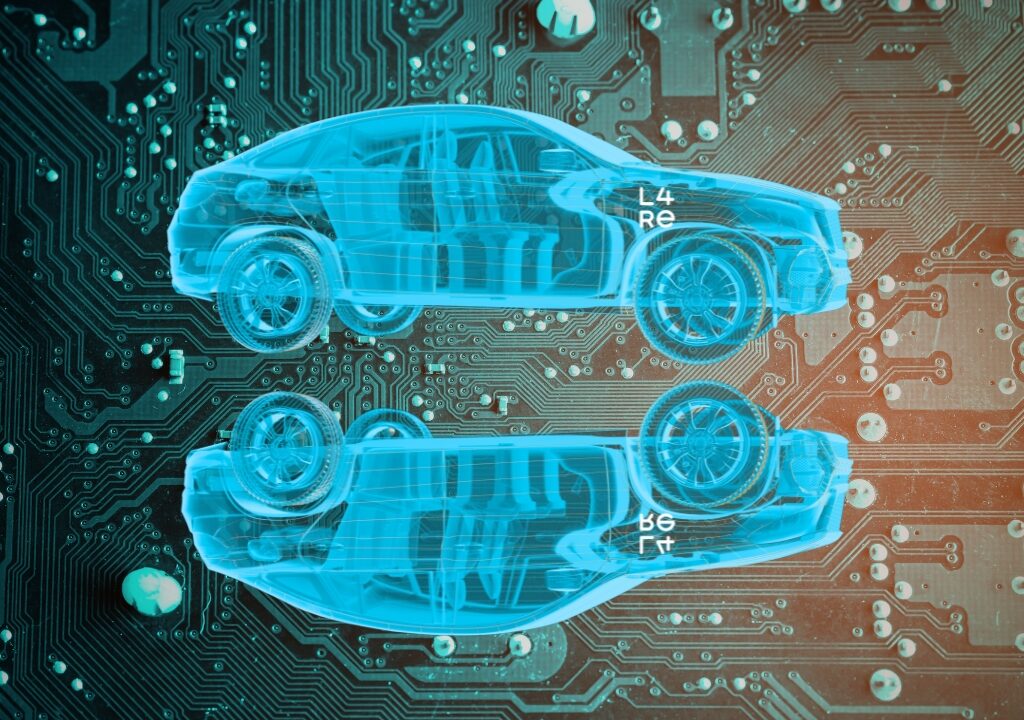
Digital twins of the latest Arm® processor designs reduce time-to-market in the automotive industry by parallelizing development processes.
The market success of today’s cars is no longer measured in terms of engine capacity, wheel size or engine power, but increasingly in terms of software, chips, and sensors. In addition, digital twins are playing a growing role in the design of such software-defined vehicles. Dresden software company Kernkonzept’s L4Re Hypervisor family supports new leading-edge automotive technologies from Arm® to enable software development to begin as soon as new Arm®-based solutions come to market.
“We are excited that our L4Re Hypervisor family can already support new leading-edge Arm® processor designs,” said Dr. Adam Lackorzynski, founder of Kernkonzept. “Digital twins make it possible. Automotive manufacturers and Tier 1 suppliers can now start their software development even before hardware is available, significantly reducing time-to-market.”
This is possible because they can begin complex and time-consuming software development as soon as a new processor generation is released in a virtual development environment. It allows hardware and software development to start simultaneously without having to wait for physical silicon to be available.
“As vehicle electronics become increasingly complex, driven by the growing AI and software needs of modern automotive applications, the industry needs to innovate faster than ever,” said Suraj Gajendra, vice president of products and solutions, Automotive Line of Business, Arm®. “A fundamental rethink of product development is needed to achieve faster time to market, and with support from leading partners like Kernkonzept, Arm® is delivering new virtual platforms and software solutions that will allow developers to start innovating as soon as our leading-edge hardware is available, without having to wait for silicon to be in production.”
With the trend of ECU-consolidation, modern vehicles are increasingly equipped with automotive high-performance computers (HPCs) that perform multiple functions in a single control unit. In some cars, a single central ‘automotive HPC’ handles all of these tasks. To prevent malfunctions in one application from affecting other applications or the entire system on an ‘automotive HPC’, the use of hypervisor technology is essential. Arm® enables consolidation through virtualization capabilities on different architectures.
The L4Re Hypervisor family allows developers to partition and isolate safety-critical systems, such as body domain control, from non-safety critical systems, such as infotainment. This ensures that critical systems are isolated and safely managed in the event of system failure. The L4Re Hypervisor family can achieve this on various Arm® architectures, including the latest state-of-the-art Arm® processors.
The combination of new Arm® virtual platforms with the L4Re Hypervisor family allows for the development of features and applications independent of the specific processor variant. Kernkonzept’s L4Re Hypervisors are just as capable of running on Arm’s high performance CPUs as they are on power-saving versions or other variants. This allows for consistent abstraction layers between hardware and software, supporting hardware-independent, flexible, and scalable system and software development.
The roots of this technology were established in 1996 at the Dresden University of Technology. The open-source orientation of the L4Re technology ensures high transparency and security. Since then, the developers and maintainers behind L4Re – many of whom have been united since 2012 in Kernkonzept GmbH – have further developed the microkernel-based operating system and adapted it for professional use. It is available as open source. Therefore, the Dresden team sees itself as a crucial component of the open-source ecosystem in and around automotive IT systems, which is also increasingly extending to the (Automotive) Cloud.
Kernkonzept joined the Scalable Open Architecture for Embedded Edge (SOAFEE) Special Interest Group to support an open and secure architecture that spans from the vehicle to the (edge-) cloud with L4Re. Expert Dr. Adam Lackorzynski is confident that “we can make significant contributions to this effort”.