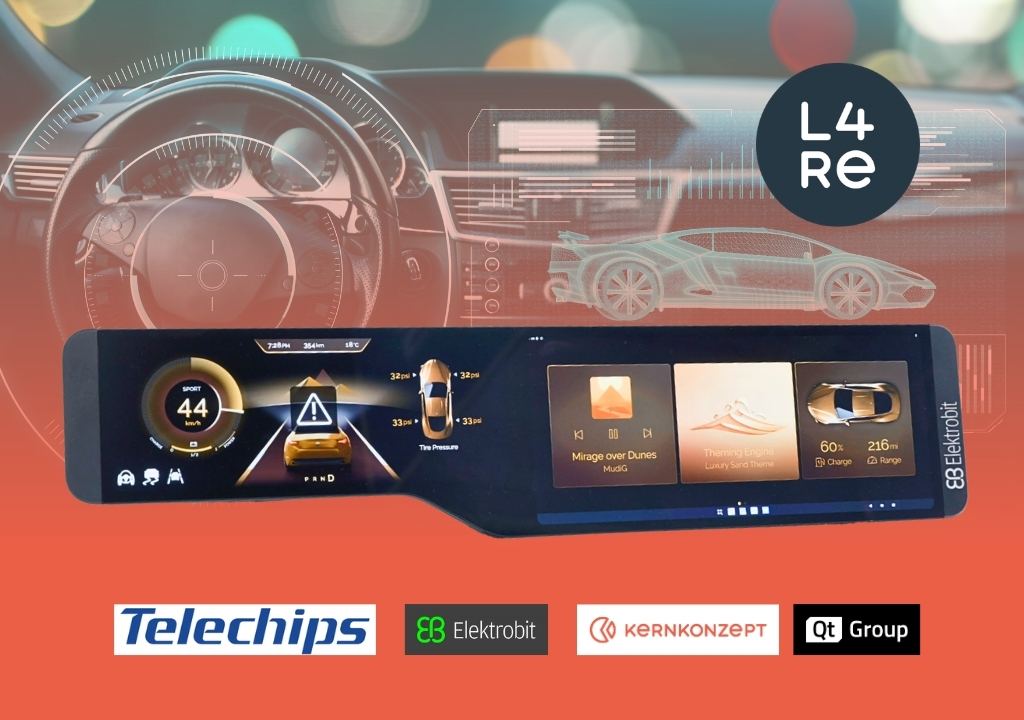
The demo focused on key issues in current vehicle architecture: separating software with different criticality levels (mixed criticality), functional safety, performance isolation, and the efficient use of graphics-intensive applications. Trade visitors could experience the integration of Android IVI, Safety Linux, and GPU virtualization working together on real hardware.
The demo’s hardware base was Telechips’ Dolphin5 platform with an Arm automotive processor and integrated automotive GPU. On this automotive SoC ran Elektrobit’s EB corbos Linux for Safety Applications for implementing safety-related cockpit functions and an advanced display solution for safety-critical telltales, enabled by the Qt Safe Renderer.
With the L4Re Hypervisor, Kernkonzept provided the virtualization and isolation layer that enables the EB Safety Linux and Android infotainment to run in parallel and strictly separated on the same Cortex®-A processor cores.
Infotainment and cluster consolidated on one HPC
The demo showed consolidated cockpit architecture in which an Android-based infotainment system (IVI) and a safety-critical instrument cluster operated simultaneously on a shared platform. Both environments ran in separate virtual machines, ensuring clear functional separation. EB corbos Linux for Safety Applications provided a Linux-based safety environment for the cluster that integrated established software components into a certifiable environment.
A key feature of the demo was the hardware-assisted graphics virtualization, which was based on the Arm Mali™-G78AE GPU of the Dolphin 5 platform. It enabled high-performance rendering of graphics-intensive content despite virtualization and showed that high graphics requirements and strict security requirements are not mutually exclusive.
Virtualization as foundation of modern cockpit systems
The technical foundation provided Kernkonzept’s L4Re framework, which isolates the individual software domains from each other and enables controlled resource allocation. This allows safety-critical and non-safety-critical applications to coexist on the same hardware without interfering with each other.
“Our technology ensures that different functional domains in the cockpit remain securely isolated from each other while still being able to work together efficiently,” explains Dr. Adam Lackorzynski, CTO and founder of Kernkonzept GmbH. “This balance of isolation, performance, and flexibility is a key success factor, especially in centralized vehicle architectures.”
“For us, the L4Re Hypervisor is the essential foundation for EB corbos Linux for Safety Applications”, adds Isaac Trefz, Senior Product Manager at Elektrobit. “Its modular architecture and small software base allows it to be made safe and fully trusted, forming the solid base required for reliable automotive software systems.”
The consistent separation of virtual machines meets both functional safety requirements and stable performance and isolation requirements – aspects that become increasingly important in the context of software-defined vehicle architectures.
Practical example of key automotive challenges
The demo addressed specific issues currently facing OEMs, Tier 1 suppliers, developers, and system architects working with central vehicle computers and cockpit platforms: How can safety and non-safety functions be consolidated on powerful central computers? How can GPU performance be efficiently distributed across multiple domains? And how can compliance with safety-related requirements be ensured?
“Our cooperation with Kernkonzept brings a lot of benefits to our customers: it simplifies development, accelerates time to market, and streamlines system validation. We are proud to showcase this joint demo at our booth, highlighting the strength of our international collaboration in real-world automotive scenarios”, summarizes Tony Park, Telechips Regional Director Europe.
embedded world as platform for embedded and automotive innovations
Kernkonzept’s presentation at embedded world 2026 built on previous trade fair appearances: The company already had its own booth in 2020, and in 2023 teamed up with Arm to showcase an Autoware demo based on the L4Re Micro Hypervisor. The regular participation underscores the strategic importance of the trade fair as Europe’s leading event for embedded technologies and automotive software.
“The demo showed in a practical way how complex requirements for safety, virtualization, and graphics performance can be reconciled in a real-world vehicle architecture,” says Lackorzynski. “This was a good example for the next generation of central cockpit and compute platforms.”