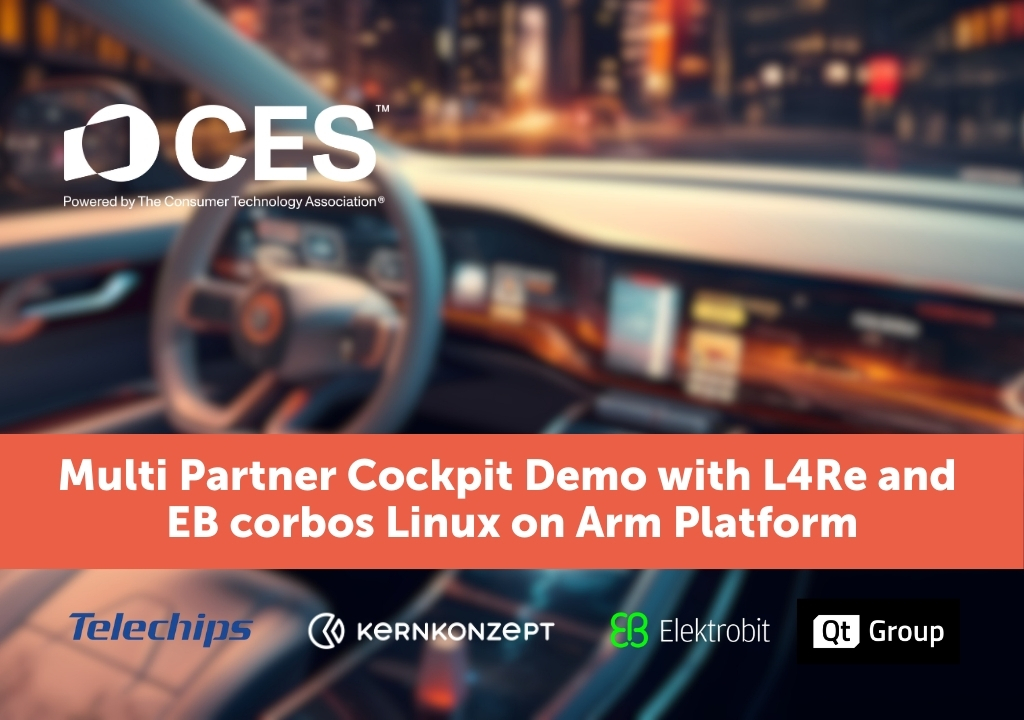
Dresden, 13. January 2026 – Along with partners Telechips and Elektrobit, Kernkonzept presented a joint demo showing how infotainment and safety critical cockpit functionalities can be integrated reliably on a single automotive hardware platform at CES 2026 Las Vegas. The demo addresses central challenges of modern vehicle architecture – from mixed criticality and functional safety to performant use of graphics intensive applications.
At CES 2026, Kernkonzept, Elektrobit and Telechips showed a joint cockpit IVI demo that integrates central SDV components on a single Arm automotive hardware. This includes the secure isolation of several host systems like Android through L4Re, secure hardware-based graphics virtualization, and a safety environment for Linux. The demo was presented by Telechips.
With the Dolphin 5 platform, Telechips provides a performant automotive central computer with Arm automotive processor and automotive graphics unit. On it, Elektrobit presented their EB corbos Linux for Safety Applications solution for safety-critical cockpit functions. Kernkonzept delivers the technological foundation for virtualization and isolation of the systems, which now allows placing Linux-based safety functions together on Cortex®-A processor cores.
Infotainment and instrument cluster on one platform
The heart of the demo is an integrated cockpit solution, which runs an Android-based infotainment system (IVI) and a safety-critical instrument cluster in parallel on a shared hardware platform. Both systems run on separate virtual machines and are strictly isolated. Elektrobit’s EB corbos Linux for Safety Applications allows operating proven and well-known software solutions in the instrument cluster and use them in the safety area.
A central element is the hardware-based graphic virtualization Arm Mali™-G78AE on Telechips’s Dolphin 5 platform. This makes it possible to present graphic intensive applications at a high-performing level even if they are executed virtually, showing that modern cockpit functions can be merged without compromising performance or reliability.
L4Re as enabler for secure virtualization
The demo’s technical foundation is the L4Re Framework by Kernkonzept. It performs the task of virtualization and isolation of the different software components and ensures that safety-critical and non-safety-critical applications can coexist.
“With L4Re, we are creating the conditions to run infotainment and instrument clusters safely, performantly, and strictly separated on a single hardware platform”, Dr. Adam Lackorzynski, CTO and founder of Kernkonzept GmbH, explains. “This combination of isolation, performance, and flexibility is crucial, especially in the cockpit.”
The clear separation of virtual machines enables functional safety while securing a stable performance isolation at the same time – a central criterion of modern software-defined vehicle architectures (SDV).
Answer to central challenges of modern vehicle architectures
The demo addresses several key topics that currently concern OEM and suppliers: especially the secure coexistence of safety-critical and non-safety-critical appliances (mixed criticality), the reliable presentation of safety-relevant information in the cockpit, and the efficient use of shared hardware resources.
“The solution demonstrates how you can unite complex tasks like safety, performance isolation, and GPU use in a realistic automotive architecture”, Lackorzynski continues. „This is a typical use case expected by car manufacturers nowadays – and it must be reliably implemented in this way.“
Strategic meaning of the CES demo
For Kernkonzept, the CES 2026 presentation has a special strategic relevance. Although the company’s technology has featured in CES demos on several occasions, it has not had its own presence at the show until now. The joint demo with Elektrobit and Telechips marks a step to gain more visibility in the international automotive ecosystem.
Since 2017, Kernkonzept and Elektrobit have been working closely together in virtualization and hypervisor technology. The CES demo showcases this partnership for the first time in the form of a fully integrated cockpit solution that complements collaboration on virtualized central control units for vehicle control. The solutions presented are based on open-source technologies; the open-source L4Re Hypervisor enables virtualization and isolation. Elektrobit‘s EB corbos Linux for Safety Applications also uses the open-source L4Re Hypervisor. Together with the Arm automotive hardware platform, this demo presents an economically attractive solution.
Relevance for OEM, tier 1 suppliers, and developers
The demo is especially geared to OEM and tier 1 suppliers, as well as developers and architects of central vehicle computers, infotainment, and cockpit systems. Decision-makers in the field of software defined vehicles and automotive software platforms also find a hands-on example for the implementation of modern vehicle architectures here.